
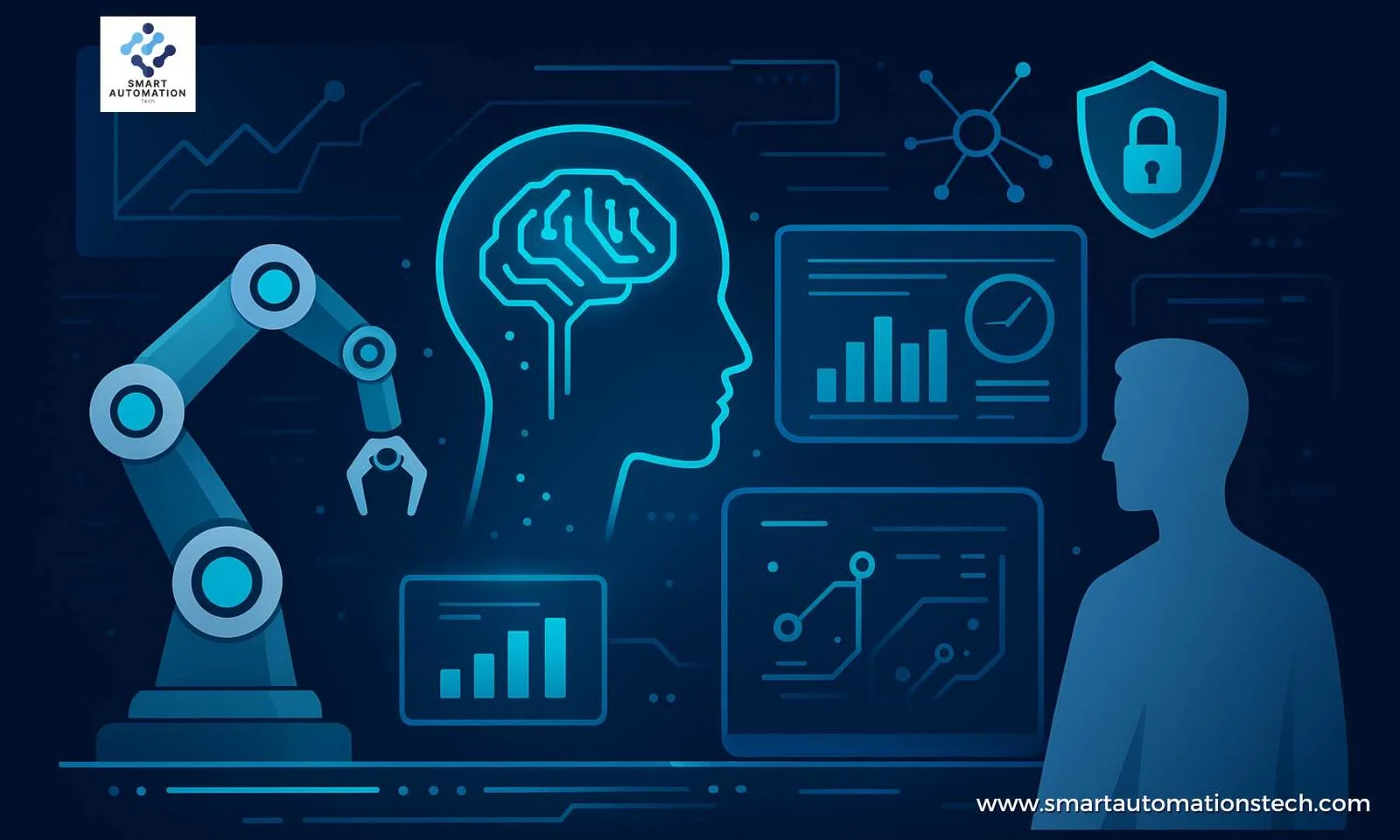
Manufacturing is no longer just about machines, assembly lines, and workers producing goods at scale. Today, factories are becoming connected, intelligent, and increasingly automated. Machines can communicate with one another, sensors can monitor equipment in real time, and artificial intelligence can help businesses understand what is happening on the production floor.
This transformation is commonly known as Industry 4.0.
In 2026, Industry 4.0 is becoming more practical for businesses of different sizes. Companies are combining artificial intelligence, industrial IoT, robotics, cloud computing, edge computing, digital twins, analytics, and advanced connectivity to improve everyday operations.
But Industry 4.0 is not simply about purchasing the latest technology. The real goal is to use technology to solve manufacturing problems, improve efficiency, reduce unnecessary downtime, and make better decisions.
In this guide, we explore the major Industry 4.0 technologies shaping modern manufacturing and how businesses can approach digital transformation in a practical way.
What Is Industry 4.0?
Industry 4.0 is the next stage of industrial development, where physical manufacturing systems become connected with digital technologies.
Traditional factories often depend on individual machines and manual monitoring. In an Industry 4.0 environment, machines can collect and share data, software can analyze that information, and employees can use those insights to make faster decisions.
For example, imagine a production machine that begins showing unusual vibration. Instead of waiting for the machine to break down, connected sensors can detect the change. Analytics software can identify the unusual pattern, while a maintenance team can inspect the equipment before a major failure occurs.
This is the basic idea behind smart manufacturing: use connected technology and data to understand what is happening and respond more effectively.
Why Is Industry 4.0 Important in 2026?
Manufacturers today face several challenges at the same time. Customer expectations are changing, production costs are under pressure, supply chains can be unpredictable, and businesses are expected to deliver products quickly without compromising quality.
Industry 4.0 can help manufacturers respond to these challenges by providing better visibility into their operations.
Instead of relying entirely on assumptions or periodic reports, businesses can use real-time information from machines, sensors, production systems, and other digital platforms.
The result is a more connected production environment where problems can be identified earlier and decisions can be based on actual operational data.
Key Industry 4.0 Technologies
Industry 4.0 includes many technologies, but some are particularly important for modern manufacturing.
1. Industrial Internet of Things (IIoT)
The Industrial Internet of Things, or IIoT, connects industrial machines and equipment to digital systems.
Sensors can collect information about machine temperature, pressure, vibration, speed, energy consumption, and other operating conditions.
This data gives manufacturers a clearer picture of what is happening on the production floor.
For example, if a machine is consuming more energy than usual, an IIoT system can flag the change. The maintenance or engineering team can then investigate the reason instead of discovering the problem much later.
IIoT also creates the data foundation needed for technologies such as predictive maintenance and industrial analytics.
2. Artificial Intelligence and Machine Learning
Artificial intelligence is becoming an important part of smart manufacturing.
Manufacturing environments can generate huge amounts of information every day. AI and machine learning can analyze this information and identify patterns that may be difficult for people to spot manually.
Businesses can use AI for:
- Predictive maintenance
- Quality inspection
- Demand forecasting
- Production planning
- Process optimization
- Anomaly detection
- Inventory management
For instance, an AI system can study historical machine data and recognize conditions that often appear before equipment failure.
AI does not eliminate the need for human expertise. Instead, it can give engineers and managers additional information to help them make better decisions.
3. Digital Twins
A digital twin is a virtual representation of a physical machine, product, process, or facility.
Think of it as a digital version of something that exists in the real world.
A digital twin can receive information from physical equipment and use that information to represent its current condition. Businesses can also use digital models to test potential changes before implementing them on real equipment.
Digital twins can be useful for:
- Equipment monitoring
- Production planning
- Maintenance
- Product development
- Process simulation
- Factory optimization
For example, before changing a production process, engineers can use a digital model to explore possible outcomes and identify potential problems.
4. Robotics and Automation
Robots have been used in manufacturing for years, but Industry 4.0 is making robotic systems more connected and intelligent.
Modern robots can work with sensors, cameras, AI systems, and other manufacturing technologies.
They can support tasks such as:
- Assembly
- Welding
- Packaging
- Material handling
- Product inspection
- Picking and sorting
Collaborative robots, often called cobots, can also be used for certain tasks alongside human workers when the appropriate safety measures are in place.
The purpose of robotics is not always to replace people. In many situations, robots can take over repetitive, physically demanding, or highly consistent tasks while employees focus on activities that require judgment, creativity, and problem-solving.
5. Edge Computing
Manufacturing machines can produce data continuously. Sending all of that information to a remote cloud platform may not always be the best approach, especially when a response is needed immediately.
Edge computing allows data to be processed closer to the machine or device that generates it.
For example, a quality-control camera on a production line can analyze products locally and identify defects without sending every image to a distant server.
Edge computing can help with:
- Faster response times
- Real-time monitoring
- Reduced network traffic
- Local data processing
- Industrial AI applications
This makes edge technology particularly useful for operations where even a small delay can affect production.
6. Cloud Computing
Cloud computing gives manufacturers a flexible way to store, manage, and analyze large amounts of information.
A business with multiple factories can use cloud-based systems to bring data from different locations into a more centralized environment.
Cloud technology can support:
- Data storage
- Analytics
- Remote monitoring
- Application integration
- Collaboration
- Business reporting
Cloud and edge computing are not necessarily competing technologies. In many Industry 4.0 environments, they work together. Edge systems handle time-sensitive processing locally, while cloud platforms can support larger-scale analysis and storage.
7. Industrial Data Analytics
Data is valuable only when businesses can turn it into useful information.
Industrial analytics helps manufacturers understand production data and identify patterns, inefficiencies, and potential opportunities.
Businesses can analyze data to answer questions such as:
- Why did production slow down?
- Which machines experience the most downtime?
- Where are quality problems occurring?
- How much energy is each production line using?
- Which processes are creating bottlenecks?
Instead of looking at manufacturing data only after something goes wrong, businesses can use analytics for continuous monitoring and improvement.
8. 5G and Advanced Connectivity
Connected manufacturing depends on reliable communication between machines, sensors, software platforms, and workers.
5G can support high-speed and low-latency communication for certain industrial applications.
Potential use cases include:
- Connected robots
- Smart warehouses
- Remote equipment monitoring
- Industrial cameras
- Mobile manufacturing systems
- Real-time machine communication
As more devices become connected, reliable networking will become increasingly important for smart factories.
9. Cybersecurity
More connectivity also means more responsibility.
When machines, sensors, cloud applications, employees, and business systems are connected, manufacturers need to protect these systems from unauthorized access and other security threats.
Industrial cybersecurity can involve:
- Access control
- Network monitoring
- Device protection
- Identity management
- Data security
- Vulnerability management
- Incident response
Cybersecurity should be considered during the design of an Industry 4.0 system rather than added only after everything has been connected.
A smart factory that is not properly protected can create operational and business risks.
10. Additive Manufacturing
Additive manufacturing, commonly known as 3D printing, creates products by building material layer by layer.
It can be useful for prototyping, customized components, complex designs, and selected production applications.
When combined with digital design software, simulation, analytics, and automated workflows, additive manufacturing can become an important part of a digitally connected production environment.
11. Augmented Reality and Virtual Reality
AR and VR can bring digital information into manufacturing and training environments.
For example, an employee wearing an AR device could receive visual instructions while performing a maintenance task. Similarly, VR can be used to simulate equipment operation or provide training without requiring access to a physical production line.
Potential applications include:
- Employee training
- Equipment maintenance
- Assembly guidance
- Remote assistance
- Factory planning
- Product design
- Simulation
These technologies can make complex information easier to understand in certain industrial situations.
How Industry 4.0 Technologies Work Together
One of the most important things to understand about Industry 4.0 is that these technologies do not have to operate independently.
They can form a connected technology ecosystem.
For example:
Sensors → IIoT → Edge Computing → Cloud → Analytics → AI → Action
A machine collects information through sensors. IIoT technology transfers that information. Edge computing can process urgent data locally, while cloud systems can store larger datasets.
Analytics can then identify patterns, and AI can help determine whether something unusual is happening.
The final decision may still involve a human employee, or the system may automatically trigger an appropriate response.
This combination is what makes Industry 4.0 different from simple factory automation.
Benefits of Industry 4.0
When implemented around genuine business needs, Industry 4.0 can provide several operational benefits.
Better Production Visibility
Connected systems allow managers and employees to see what is happening across production processes more clearly.
Reduced Equipment Downtime
Predictive maintenance technologies can help identify potential equipment problems earlier.
Improved Quality Control
Sensors, cameras, AI, and analytics can support more consistent quality monitoring.
Faster Decision-Making
Real-time information can help employees respond to operational problems sooner.
Improved Resource Management
Businesses can use production data to understand how materials, machines, energy, and other resources are being used.
Greater Manufacturing Flexibility
Connected and programmable systems can make it easier to adapt production when products or customer requirements change.
Challenges Businesses Need to Consider
Although Industry 4.0 offers many opportunities, implementation is not always straightforward.
Legacy Equipment
Older machines may not have modern connectivity capabilities. Connecting them to newer systems may require additional hardware or integration work.
Data Quality
Poor-quality or incomplete data can reduce the usefulness of analytics and AI.
Cybersecurity Risks
Connecting more machines and systems can increase the number of areas that need protection.
Skills and Training
Employees may need new skills in areas such as data analytics, automation, AI, networking, and cybersecurity.
Integration Problems
Different machines and software platforms may use different technologies and communication standards.
Cost
Industry 4.0 requires investment in technology, integration, training, maintenance, and security.
For these reasons, businesses should avoid treating digital transformation as a single large technology purchase.
How to Start an Industry 4.0 Transformation
A company does not need to transform its entire factory at once.
Starting with a focused problem can often make the process easier to manage.
Step 1: Identify a Business Problem
Start with a specific issue, such as frequent machine downtime, quality problems, high energy consumption, or inefficient production planning.
Step 2: Review Existing Technology
Understand what machines, sensors, software, networks, and data systems are already available.
Step 3: Select a Practical Use Case
Choose one area where digital technology could provide measurable value.
Step 4: Run a Pilot Project
Test the solution on a limited production line, machine, or process.
Step 5: Measure the Results
Compare performance before and after implementation.
Step 6: Expand Gradually
If the pilot delivers useful results, expand the solution to other areas of the business.
This approach allows manufacturers to learn from smaller projects before making larger investments.
The Future of Industry 4.0
Industry 4.0 is moving toward greater cooperation between technologies.
AI can analyze industrial data. IIoT can collect that data. Edge computing can process information close to machines. Cloud platforms can connect information across facilities. Digital twins can represent physical processes, while robotics can perform physical tasks.
The future will therefore be less about individual technologies and more about how effectively these technologies work together.
At the same time, manufacturers will need to pay attention to cybersecurity, data quality, interoperability, employee training, and responsible use of AI.
The most successful Industry 4.0 projects are likely to be those that combine technology with a clear understanding of real manufacturing needs.
Conclusion
Industry 4.0 is changing manufacturing from a collection of isolated machines into a more connected and intelligent environment.
Technologies such as IIoT, artificial intelligence, machine learning, robotics, digital twins, edge computing, cloud computing, analytics, 5G, additive manufacturing, and cybersecurity are helping businesses rethink how products are designed, produced, monitored, and improved.
However, adopting Industry 4.0 is not about using every available technology. Businesses should begin with clear objectives, identify specific operational problems, and select technologies that address those problems.
In 2026, the focus is increasingly shifting from simply automating individual tasks to creating manufacturing systems that can connect information, understand changing conditions, and support better decisions.
That is what makes Industry 4.0 an important part of the future of modern manufacturing.
Frequently Asked Questions
1. What is Industry 4.0?
Industry 4.0 refers to the use of connected and intelligent technologies such as AI, IIoT, robotics, analytics, and digital twins to improve manufacturing operations.
2. What are the main technologies used in Industry 4.0?
Major Industry 4.0 technologies include artificial intelligence, Industrial IoT, robotics, digital twins, edge computing, cloud computing, industrial analytics, 5G, and cybersecurity.
3. How does Industry 4.0 benefit manufacturers?
Industry 4.0 can help manufacturers improve production visibility, reduce equipment downtime, strengthen quality control, optimize resources, and make faster data-driven decisions.
4. How can a business start adopting Industry 4.0?
A business can begin by identifying a specific operational problem, evaluating its existing technology, selecting a practical use case, testing a small pilot project, and gradually expanding successful solutions.


