

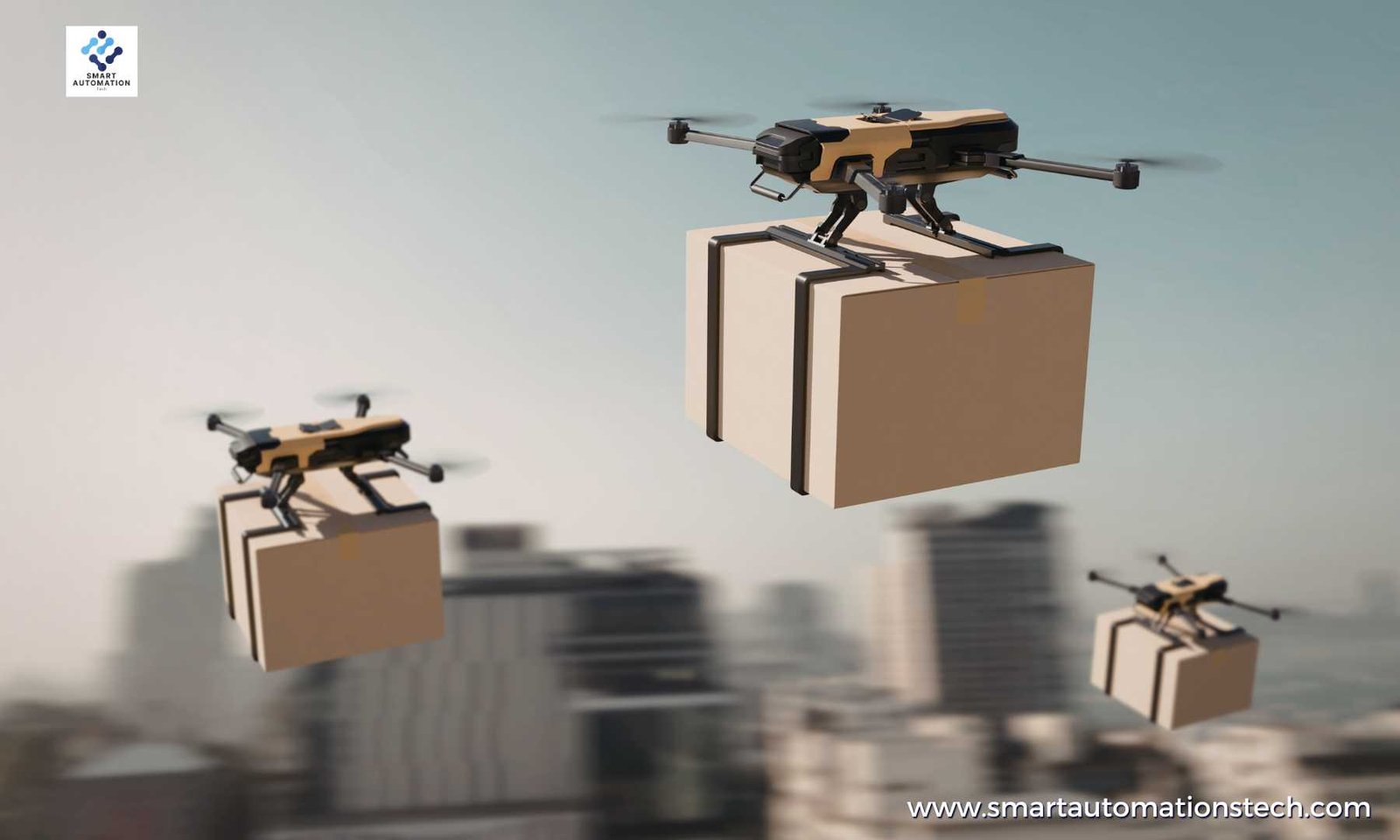
Same-day delivery has changed what customers expect from online shopping. People no longer want to wait several days for an order that could potentially arrive within hours. As e-commerce continues to grow, businesses are looking for faster, safer, and more efficient ways to move products from warehouses to customers.
One technology attracting growing attention is autonomous delivery drones.
These unmanned aircraft can transport lightweight packages over short distances without requiring a driver to physically operate the vehicle throughout the journey. By combining artificial intelligence, GPS, sensors, cameras, route planning, and automation, delivery drones are creating new possibilities for last-mile logistics.
The idea is simple: instead of sending a delivery vehicle through busy roads, a drone can travel through the air and potentially reach its destination more directly.
But autonomous delivery is about more than speed. It could also influence delivery costs, traffic congestion, operational efficiency, and the way businesses design their logistics networks.
What Are Autonomous Delivery Drones?
Autonomous delivery drones are unmanned aerial vehicles designed to transport packages with limited or no direct human control during the flight.
These systems typically use technologies such as GPS navigation, cameras, sensors, artificial intelligence, obstacle detection, and automated flight-control systems. Together, these technologies help the drone understand its surroundings, follow a planned route, and respond to changing conditions.
A typical delivery process may begin when an order is prepared at a fulfillment center. The package is placed inside the drone’s delivery compartment, and the system receives the destination information. After completing required safety checks, the drone follows its approved route toward the delivery location.
Depending on the system, the package may be lowered to a designated area or delivered through another controlled drop-off method.
The important difference is that the delivery process can be heavily automated, reducing the amount of manual intervention required for every individual shipment.
Why Same-Day Delivery Needs New Technology
Traditional last-mile delivery can be complicated.
Delivery vehicles must deal with traffic, road conditions, parking limitations, fuel consumption, and driver availability. These challenges become even more noticeable when customers expect their orders to arrive on the same day.
For businesses handling thousands of deliveries, even small delays can create significant operational problems.
Autonomous delivery drones offer another approach. A drone can potentially avoid road congestion and travel directly between suitable points. This can make short-distance deliveries more flexible, particularly in areas where road travel takes considerably longer than the actual distance between the warehouse and customer.
However, drones are not intended to replace every delivery method. Their usefulness depends on factors such as package size, distance, weather, regulations, infrastructure, and local operating conditions.
How Autonomous Delivery Drones Work
Several technologies work together to make autonomous delivery possible.
Artificial Intelligence
AI can help delivery systems analyze routes, recognize objects, process sensor information, and make automated navigation decisions.
As the drone moves through an environment, its onboard systems can process information from multiple sensors. This helps it maintain awareness of nearby objects and changing conditions.
GPS and Navigation
GPS provides positioning information that helps the drone understand where it is and where it needs to go.
Advanced navigation systems can combine GPS with other technologies to improve positioning and route accuracy, particularly when operating conditions become more complicated.
Sensors and Cameras
Sensors can detect objects and environmental conditions around the drone. Cameras may provide visual information that helps the system identify obstacles or understand its surroundings.
This combination is particularly important because autonomous systems need more than a predefined route. They also need to react when something unexpected happens.
Automated Flight Control
Flight-control systems manage functions such as altitude, direction, speed, and stability.
Automation allows the drone to follow its planned journey without requiring a person to continuously control every movement.
Benefits of Autonomous Delivery Drones
Faster Local Deliveries
One of the biggest potential benefits is faster delivery for short-distance orders.
Instead of navigating congested streets, a drone may travel more directly through the air. For urgent products such as certain medical supplies, replacement components, or time-sensitive goods, this capability could be especially useful.
Lower Road Congestion
If a portion of suitable deliveries moves from roads to the air, businesses could potentially reduce the number of delivery trips made by conventional vehicles.
The overall effect would depend on how drones are deployed and what types of deliveries they replace.
Improved Delivery Efficiency
Automation can help businesses coordinate deliveries more efficiently. A centralized system could monitor drone availability, package status, routes, and delivery progress.
This can give logistics teams better visibility into their operations.
Potential Reduction in Operating Costs
Drones do not require a conventional driver for every delivery. Once the necessary infrastructure is established, businesses may be able to automate certain repetitive delivery tasks.
However, this does not mean drone delivery is automatically inexpensive. Companies still need to consider equipment, maintenance, software, charging infrastructure, monitoring, insurance, compliance, and other operating expenses.
Flexible Delivery Options
Autonomous drones could create new options for businesses that need to deliver small packages quickly within a defined geographic area.
Instead of relying on a single delivery model, companies could combine drones with vans, bikes, autonomous vehicles, and traditional logistics networks.
Challenges That Delivery Drones Must Overcome
Despite their potential, autonomous delivery drones face several challenges.
Weather Conditions
Strong winds, heavy rain, storms, and other environmental conditions can affect drone operations.
A reliable delivery network therefore needs systems that can monitor weather conditions and determine when flights should be delayed or canceled.
Regulations and Airspace
Drones operate within regulated airspace, and businesses must follow applicable aviation and safety requirements.
Rules can vary by country and operating environment. Companies therefore need to design their drone programs around local regulations rather than assuming that autonomous delivery can operate anywhere.
Safety
Safety is one of the most important considerations.
A delivery drone must be capable of identifying obstacles and responding appropriately when unexpected situations occur. Businesses also need procedures for handling technical failures, communication problems, emergency landings, and other risks.
Package Limitations
Most delivery drones are designed for relatively lightweight packages.
Large, heavy, or unusually shaped products may still require conventional vehicles. This means drones are more likely to become part of a broader delivery network rather than a complete replacement for traditional logistics.
Public Acceptance
People may have concerns about drones flying near homes, businesses, schools, and public spaces.
Noise, privacy, safety, and visual clutter can influence how communities respond to drone delivery programs. Companies will need to consider these concerns when developing large-scale operations.
Autonomous Drones and the Future of Logistics
The future of delivery is unlikely to depend on a single technology.
Instead, logistics could become a combination of automated and traditional systems. A large shipment might travel by truck to a local distribution center, while smaller urgent packages could be transferred to drones for the final part of the journey.
Artificial intelligence can connect these different systems and help determine which delivery method is appropriate for each order.
For example, an automated logistics platform could consider package weight, destination, delivery deadline, traffic conditions, weather, and available transportation resources before selecting a delivery method.
This type of intelligent coordination could make logistics networks more responsive.
How Businesses Can Prepare for Drone Delivery
Companies interested in autonomous delivery should begin with realistic use cases rather than immediately attempting to automate their entire delivery network.
Businesses can start by identifying products and delivery routes that are suitable for drone transportation. They can then evaluate operational requirements, regulatory conditions, infrastructure, and customer expectations.
Data will also play an important role.
Businesses can analyze delivery times, order locations, package weights, failed deliveries, and transportation costs to determine where autonomous delivery could provide meaningful value.
Integration with existing logistics software is equally important. A drone should not operate as an isolated system. It needs to communicate with inventory platforms, order management systems, warehouse software, tracking tools, and customer notification systems.
The Role of AI in Autonomous Delivery
AI is becoming one of the most important technologies behind autonomous transportation.
In drone delivery, AI can support navigation, object detection, route optimization, fleet management, and operational decision-making.
As these systems become more sophisticated, drones may become better at responding to dynamic environments instead of simply following predetermined routes.
However, greater autonomy also increases the importance of testing, monitoring, cybersecurity, and human oversight. Automation should be designed with clear safety procedures and appropriate controls.
Final Thoughts
Autonomous delivery drones could significantly change the way businesses approach same-day shipping. Their ability to combine automated flight, AI-powered navigation, sensors, and digital logistics systems creates new opportunities for faster and more flexible deliveries.
At the same time, drone delivery is not a universal replacement for trucks, vans, or human delivery workers. Regulations, weather, safety, package limitations, infrastructure, and public acceptance all influence where the technology can be used effectively.
The most practical future may be a connected logistics ecosystem where drones work alongside traditional transportation methods.
As automation technology continues to develop, businesses that understand these systems early can better evaluate where autonomous delivery fits into their future logistics strategy.
Frequently Asked Questions
1. What are autonomous delivery drones?
Autonomous delivery drones are unmanned aircraft that use technologies such as GPS, sensors, cameras, and AI-powered navigation to transport packages with limited human control.
2. How can delivery drones support same-day shipping?
Delivery drones can travel directly through the air and avoid some road congestion, making them useful for certain short-distance and time-sensitive deliveries.
3. What technologies are used in autonomous delivery drones?
Autonomous delivery drones can use artificial intelligence, GPS, cameras, sensors, automated flight controls, route-planning systems, and communication technologies to manage deliveries.
4. What are the main challenges of autonomous drone delivery?
Key challenges include weather conditions, aviation regulations, safety requirements, package-size limitations, infrastructure needs, cybersecurity, and public acceptance.


